


I wake up to the beeping alarm clock. My electric toothbrush beeps when it’s time to move to the next quadrant. I weigh myself, and the scale beeps to tell me it has a reading.
I get dressed and my phone beeps to let me know I have email. It beeps again to tell me that a DM has arrived. I crack a couple of eggs into a mug and put them in the microwave. I push the 4, it beeps, push the 5, it beeps, push start, it beeps. 45 seconds later a steady stream of beep-beep-beeps tells me to stir the eggs. The whole thing repeats.
Standing at the elevator, I push the down button. Beep. The elevator arrives. Beep. The doors open. I push G. Beep. Each floor we pass is shown on the display, with an accompanying beep. We get to the ground floor, there’s a beep, the door opens.
Our days are filled with beeps, short bursts of sound designed to catch our attention. These beeps are not natural sounds. They are each the result of choices by one or more human beings who chose the frequency of the sound, its volume, timbre, and duration.
Or not. I had a fantasy that these beeps are created by stressed-out engineers tasked with making a sound - any sound - under ridiculous time and cost constraints, so they all ended up with about the same sound. I was almost right. It turns out that these beeps don’t just sound alike: they are alike.
We live among the cloned armies of beeps.
The main culprit is the piezo disk, a tiny, super cheap little flat ceramic disk glued onto a slightly larger, flat metal plate. Hit the disks with electricity, and the ceramic expands, causing it to bulge upwards into a dome. This pushes the air away, and when that air reaches our ears we hear a click. Do that thousands of times a second and we hear the clicks like a single tone.
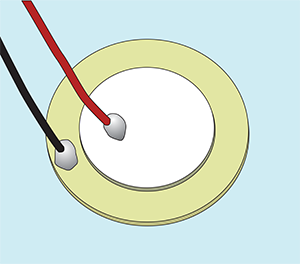
So the tone is fixed, but you can still pick the frequency and give it some personality, right?
Sadly, no. By buzzing the disk about 4,000 times per second you get maximum loudness at minimal power. In fact, you can buy super-cheap variations of this thing called active piezo buzzers that generate a tone locked to this frequency. Just turn it on and then off and you get your beep.
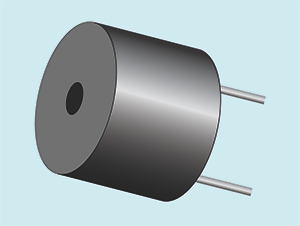
Even better, human hearing is near its peak sensitivity around that frequency. That’s good news, because the beep being made by your coffee maker or smart watch is very important. Very, very important. It’s the most important thing imaginable. So everyone chooses that frequency not only to save battery but to punch through the insignificant background noise of your friend’s latest breakup story, the music you’re enjoying, or any other irrelevancies that pale in comparison to being alerted that your washing machine is moving on to the next cycle.
Happily, some companies are moving away from these beeps. I’ve used some appliances from LG that play short tunes when their work is done, but that’s rare. Beeps are still everywhere.
Songbirds are all different, even birds of the same species. Every guitar sounds like itself. We know our friends from a single word. But every beep is the same beep.
Road Runner? Is that you?
Beep beep beep. Back it up.
Smoke detector (grab that towel and fan like crazy)
Bark collars. (I tried one on my son Austin. It worked. He still doesn’t bark.)
My Tesla has lots of beeps.
I heard that the early versions of Excel used to beep when you made a mistake. That was a cause of dishonor in Japan.
That microwave oven beep though… truly annoying when it doesn’t shut up.
BTW - read your proton email. I sent you a short note.